 1
1
 0
0
Snowflake + n8n: Over the last few weeks, I kept coming across n8n while casually scrolling through Facebook and other tech discussions.And eventually I had the obvious question:
Can n8n actually be useful with Snowflake?
I had never worked with n8n before, so started as a simple Snowflake connectivity experiment with n8n and ended up connecting:
n8n + OpenAI + Snowflake + GitHub
to create an AI-powered data incident workflow.
Problem:
Problem:
Imagine somebody reports:
“The sales dashboard is showing zero orders for India today. Can someone investigate?”
This sounds like a simple message.
But behind that message, someone normally has to figure out:
- Which dataset is affected?
- Did the data pipeline fail?
- Did the data-quality check fail?
- Which team owns the dataset?
- How severe is the issue?
- Should an incident ticket be created?
Instead of manually performing all these steps, could n8n coordinate different systems and automate the journey?
The Workflow I Built
The Workflow I Built
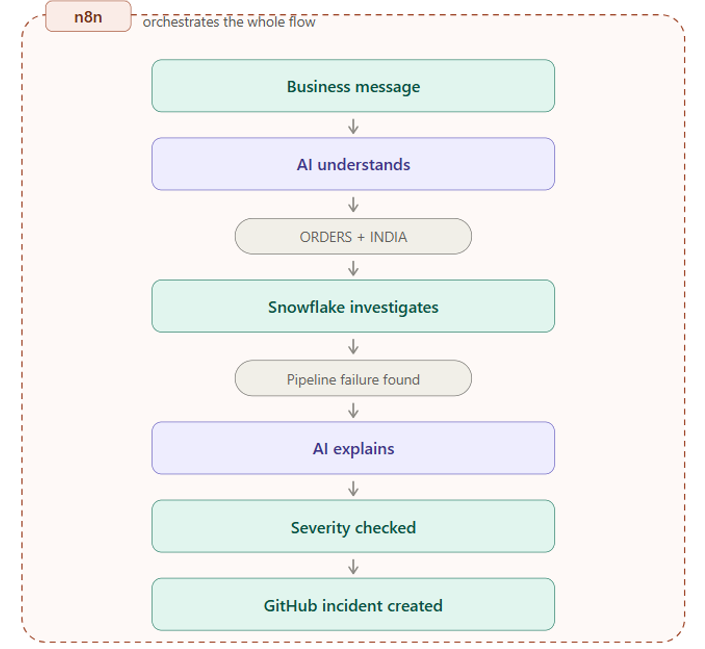
My final workflow looked like this:
Step 1: Start With a Business Problem
I manually supplied this message:
Sales dashboard is showing zero orders for India today. Please investigate.
Why manual: Because my objective was first to understand n8n orchestration
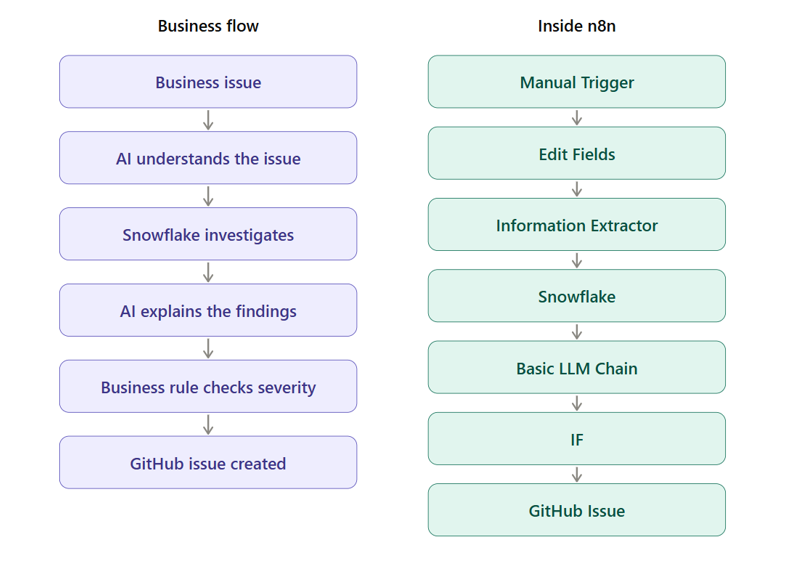
So the first two components were simply:
Manual Trigger
↓
Edit Fields
The Edit Fields node held one value: with our sample business problem.
user_message
Why this step matters
Today the message is manually entered.
Tomorrow it could arrive from:
Slack,Teams,Email,Webhook
The rest of the workflow does not need to fundamentally change.
Step 2: Let AI Understand What the User Means
User simply said: Sales dashboard is showing zero orders for India.
A human immediately understands that the problem is related to orders and India.
A SQL query does not. So I added an Information Extractor connected to an OpenAI model.
Human language -> AI -> Structured information
The result became something like:
Dataset : ORDERS
Region : INDIA
Issue Type : MISSING_DATA
Now the workflow is not dependent on one exact sentence.
The user could say:
“No orders are appearing for India.”
or:
“India sales seems empty today.”
The AI layer converts that natural language into information the next system can understand.
Step 3: Let Snowflake Find the Facts
Once n8n knows: Dataset = ORDERS and Region = INDIA, Snowflake node received ORDERS and INDIA dynamically and investigated the problem.
Snowflake returned evidence such as:
Evidence:
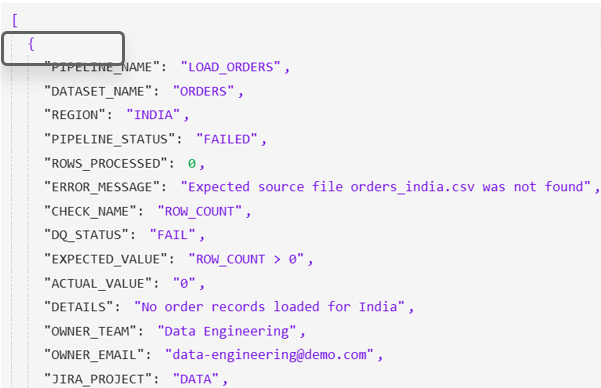
Snowflake provides the facts.
The pipeline failed. The source file was missing. Zero rows were processed.
The data-quality check failed.
Step 4: Let AI Explain the Technical Result
Snowflake gave us the facts. But not the way how we want to communicate with a business user. So I added a second AI step using a Basic LLM Chain. Responsibility of this step to explain Snowflake’s findings.
The model received the Snowflake evidence and produced something like:
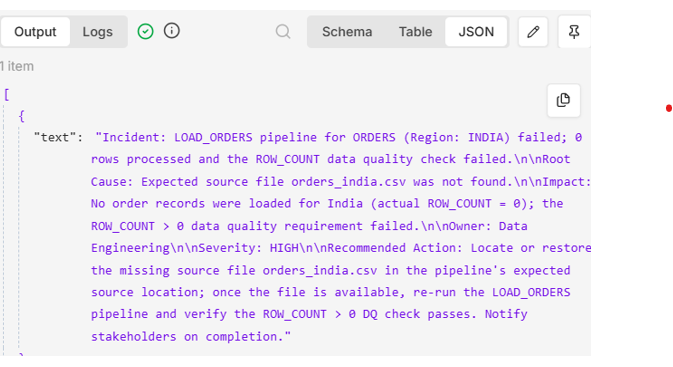
Step:
Step 5: Should AI Decide Whether to Create a Ticket?
The AI output already contained: Severity: HIGH, So added an n8n IF node.
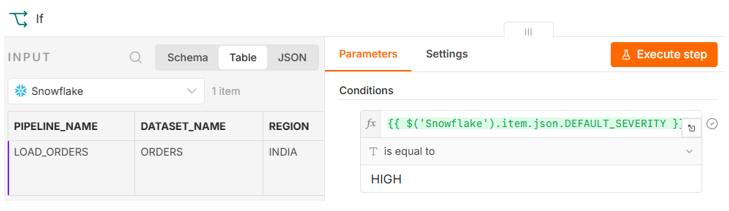
If Snowflake severity = HIGH then Create an Incident.
Step:
Step 6: Automatically Create the Ticket
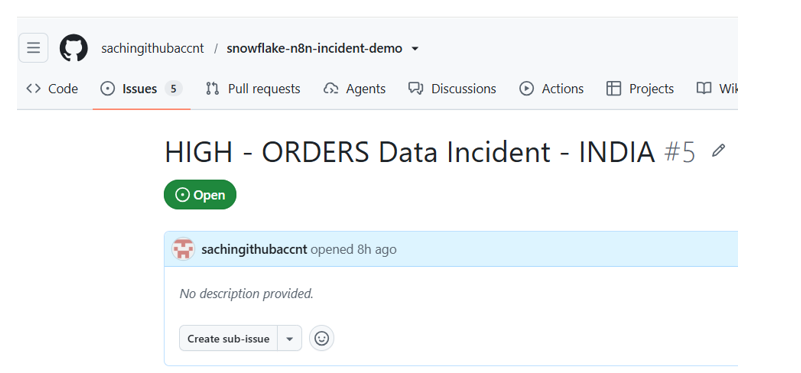
If the incident severity is HIGH, n8n automatically creates an issue.
For example:
HIGH – ORDERS Data Incident – INDIA
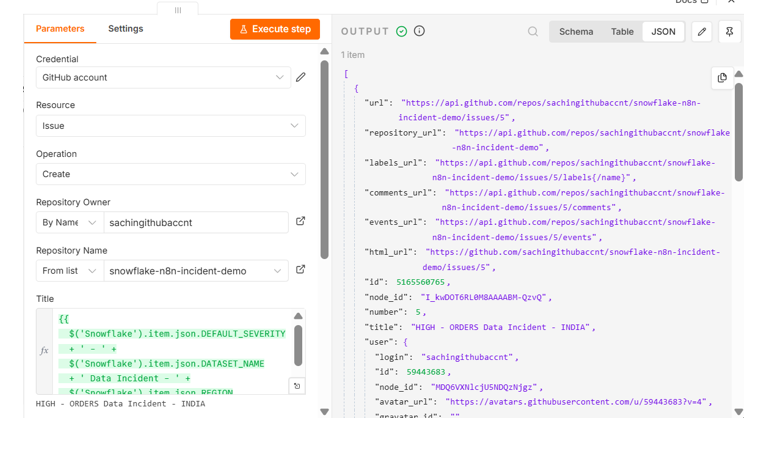
What Was n8n Actually Doing.
n8n is an orchestration layer that allows different systems to participate in one business process without writing a large integration application.
n8n wasn’t replacing any of these technologies.
It wasn’t replacing Snowflake, OpenAI or GitHub.
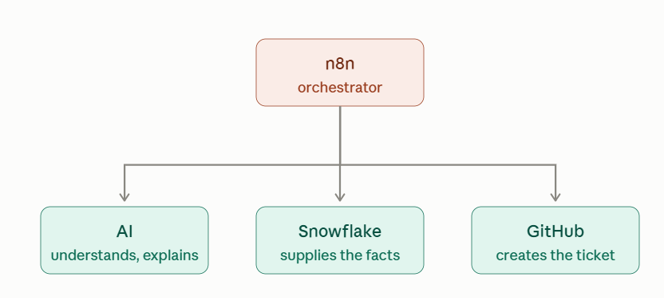
Each system does what it is good at.
OpenAI
Understand natural language and explain technical results.
Snowflake
Store and investigate trusted operational data.
GitHub
Track the incident.
n8n
Connect all of them and decide what happens next.
What About Slack?
My current POC starts manually and we can enhance it to integrate with Slack.
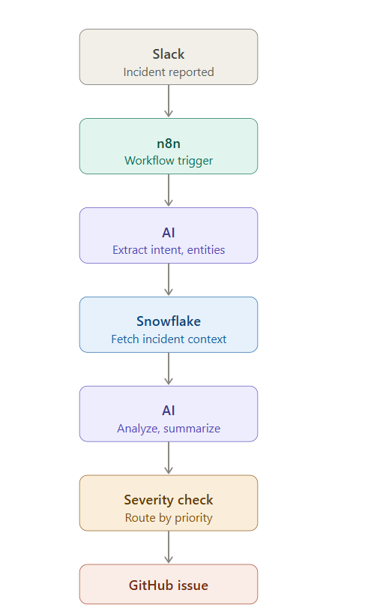
A user could simply write:
“Sales dashboard is showing zero orders for India. Please investigate.”
n8n could run the entire workflow and eventually respond with the created incident.